











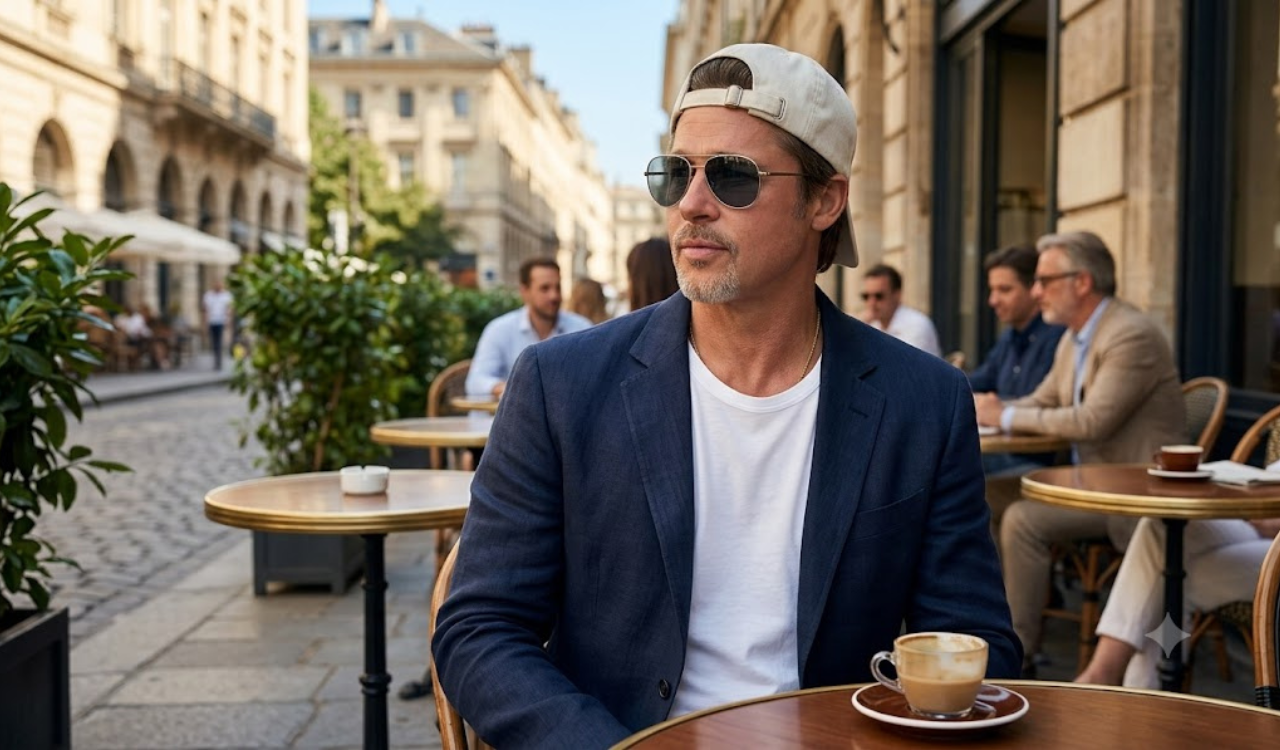
Brad Pitt Young: The Formative Years of Hollywood’s Most Enduring Leading Man
Brad Pitt Young entered the world on December 18, 1963, in Shawnee, Oklahoma, though his childhood truly took shape in Springfield, Missouri, where his family relocated during his early years. Growing up in a conservative Southern Baptist household, young Brad was surrounded by the values of hard work and community service, with his father operating a successful trucking company and his mother serving as a school counselor. As the eldest of three children, he naturally assumed a leadership role within his family,
displaying an early interest in the arts by participating in school plays and singing in the church choir, though no one could have predicted that this quiet Midwestern boy would one day become one of the most recognizable faces on the planet. His childhood was remarkably normal, filled with football games, fishing trips, and the kind of wholesome American experiences that would later inform his grounded approach to fame and his ability to connect with audiences from all walks of life.
The Bold Decision to Abandon Academia for Hollywood Dreams
Brad Pitt’s journey to stardom began with a seemingly conventional path when he enrolled at the University of Missouri to study journalism and advertising, following in the footsteps of many young men seeking a practical and stable career. During his time at university, he joined the Sigma Chi fraternity and was considered a dedicated student, but something fundamental shifted within him as he approached graduation, just two credits shy of earning his degree.
The pull of the silver screen proved too powerful to resist, and with characteristic determination, he made the audacious decision to leave college behind and pursue acting full-time, packing his Datsun with whatever belongings he could fit and heading west to Los Angeles with only a few hundred dollars to his name. This pivotal moment represented a complete rejection of the safe, predictable life his parents had envisioned for him, and it demonstrated the kind of courage and self-belief that would become hallmarks of his career, as he essentially bet everything on his ability to succeed in an industry known for crushing dreams.
Surviving the Brutal Realities of Hollywood’s Underground
The reality of life as a struggling actor in Los Angeles was far removed from the glamorous images Brad Pitt had envisioned, and he spent his early years in Hollywood enduring a series of humbling jobs that tested his resolve and resilience. Living out of his car and sleeping on friends’ couches, he took whatever work he could find, including delivering refrigerators, driving limousines, and even dressing up in a giant chicken costume to promote a fast-food restaurant, experiences that grounded him and gave him a deep appreciation for the value of hard work. Perhaps most famously,
he worked as a chauffeur for strippers at bachelor parties, a job he later described as anything but wholesome, yet these experiences provided him with invaluable insights into the diverse tapestry of Los Angeles life and the determination to keep pushing forward despite constant rejection. These years of struggle, often romanticized in Hollywood biographies, were genuinely difficult and required immense persistence, but they forged in him an unshakeable work ethic and a refusal to give up on his dreams, qualities that would serve him well when opportunities finally began to materialize.
The Television Apprenticeship That Built His Foundation
Before the world knew his face, Brad Pitt paid his dues in the unforgiving world of television, appearing in a series of guest roles and bit parts that helped him develop his craft and gain valuable on-set experience. His early credits included appearances on popular shows like Dallas, 21 Jump Street, and Growing Pains, where he often played handsome but forgettable characters that barely registered with audiences or critics alike. He also secured a recurring role on the soap opera Another World, a stint that provided him with steady work and the opportunity to practice his craft daily
, though he would later admit that the fast-paced nature of soap opera production was both challenging and educational. A particularly memorable moment came when he appeared in a Pringles commercial in 1989, which not only earned him his Screen Actors Guild card but also demonstrated his ability to capture attention even in a thirty-second spot, a skill that would prove invaluable when he finally landed his breakthrough role. These television appearances, while modest, built the foundation for his eventual superstardom, teaching him the technical aspects of acting and the importance of professionalism on set.
The Serendipitous Audition That Changed Everything
Fate intervened in Brad Pitt’s career in a way that seemed almost destined when he accompanied a classmate to an audition and ended up performing the scene himself, impressing the agent so thoroughly that he was signed on the spot. This seemingly small moment of good fortune proved to be the turning point in his career, opening doors that had previously remained firmly closed and providing him with the professional representation he desperately needed to advance his career. The agent recognized something special in the young actor, a combination of raw talent,
natural charisma, and undeniable screen presence that set him apart from the countless other handsome faces vying for attention in Hollywood. This fortunate encounter led directly to his first significant film role, as casting directors began to take notice of this fresh-faced actor with the chiseled features and magnetic energy, setting the stage for the breakthrough that would change his life forever. The story of this audition has become part of Hollywood legend, serving as a reminder that sometimes success depends not just on talent and hard work, but also on being in the right place at the right time.
Thelma and Louise and the Birth of a Heartthrob
The 1991 release of Ridley Scott’s Thelma & Louise marked the moment when Brad Pitt young exploded onto the global consciousness, transforming from an unknown actor into an international heartthrob almost overnight. His portrayal of J.D., the charming and handsome cowboy hitchhiker who shares a passionate encounter with Geena Davis’s character, required only a few minutes of screen time, yet his impact was so profound that audiences rewound their VHS tapes repeatedly just to catch another glimpse of him. The scene where he removes his shirt revealed a physique that would become iconic, and his easy charm and mischievous smile captivated viewers worldwide,
earning him comparisons to classic Hollywood leading men while establishing him as a fresh new face for a new generation. This breakthrough performance came at exactly the right moment in popular culture, as audiences were hungry for a new kind of male star who combined traditional good looks with a rebellious edge and an unmistakable air of danger. The success of the film and the overwhelming response to his performance opened every door in Hollywood, but rather than rushing to capitalize on his newfound fame, Brad Pitt carefully considered his next moves, determined to build a career of substance rather than simply coasting on his appearance.
A River Runs Through It and the Art of Subtle Performance
Following his breakthrough, Brad Pitt demonstrated remarkable strategic thinking by choosing to work with legendary director Robert Redford on A River Runs Through It, a quiet, contemplative film about fly fishing and family bonds set against the stunning backdrop of Montana. In this film, he played Paul Maclean, the free-spirited and rebellious younger brother whose charisma masks a self-destructive streak, a role that allowed him to showcase his acting abilities beyond his physical appeal. Redford, who had himself navigated the transition from heartthrob to respected actor,
recognized something special in the young performer, describing him as having an interesting inner conflict that made him compelling to watch on screen. The film required Pitt to deliver a nuanced performance that relied more on subtle expressions and body language than dramatic dialogue, and he rose to the challenge, proving that he possessed genuine acting talent rather than just a pretty face. Critics took notice of his ability to hold his own against more experienced actors, and the film’s success established him as a serious dramatic actor capable of carrying a major motion picture, setting the stage for the diverse and challenging roles that would follow.
The 1990s Career Renaissance and Defying Typecasting
Throughout the 1990s, Brad Pitt consciously avoided being pigeonholed as simply a handsome leading man, instead seeking out diverse and often challenging roles that showcased his range and willingness to take risks. He portrayed a philosophical killer in Kalifornia, a sweet-natured pot-smoking hippie in True Romance, and a tortured soul in Legends of the Fall, each performance revealing a different facet of his talent and his refusal to be defined by his appearance.
His role as Detective David Mills in David Fincher’s Seven was a particularly significant departure from his romantic leading man image, as he portrayed a young cop descending into darkness while hunting a serial killer, a performance that was both gritty and emotionally raw. The Academy took notice of his versatility, nominating him for Best Supporting Actor for his wild, paranoid performance in Terry Gilliam’s 12 Monkeys, a role that demonstrated his willingness to disappear into characters and take creative risks that other actors of his stature might avoid. This period of his career established him as one of the most exciting and unpredictable actors of his generation, capable of alternating between mainstream blockbusters and challenging independent films with equal skill and commitment.
Fight Club and the Transformation Into Cultural Icon
The release of Fight Club in 1999 represented a watershed moment in Brad Pitt’s career, as his portrayal of Tyler Durden, the charismatic and anarchic soap salesman who inspires an army of disaffected men, redefined his public image and cemented his status as a cultural icon. The role required a complete physical transformation, as Pitt built lean, wiry muscle and adopted a dangerous, unpredictable energy that made his character both magnetic and terrifying, a performance that would influence fashion, masculinity, and popular culture for decades to come.
Tyler Durden’s philosophy of anti-consumerism and radical self-destruction resonated deeply with audiences at the turn of the millennium, and Pitt’s embodiment of this character was so complete that many fans still consider it his greatest performance. The film’s controversial themes and Pitt’s fearless portrayal pushed the boundaries of mainstream cinema, establishing him as an actor willing to tackle provocative material and challenge audience expectations. This role marked the culmination of his evolution from the young heartthrob of Thelma & Louise to a more complex, intense figure who could command the screen through sheer force of personality, and it ensured that his legacy would extend far beyond his youthful good looks.
Personal Life and Relationships During His Rise to Fame
Throughout his rise to fame, Brad Pitt’s personal life attracted as much media attention as his film career, with his high-profile relationships and marriages becoming regular tabloid fodder and public fascination. His two-year relationship with Gwyneth Paltrow in the mid-1990s was one of Hollywood’s most talked-about romances, with the couple frequently appearing together at premieres and events, though their eventual breakup was handled with considerable grace and mutual respect.
His subsequent marriage to Jennifer Aniston in 2000 was a media sensation, with their wedding being one of the most anticipated celebrity events of the decade, and the couple quickly became known as one of Hollywood’s golden pairs. Despite the intense scrutiny of his personal life, Pitt maintained a degree of privacy and mystery, rarely speaking to the press about his relationships and preferring to let his work speak for itself. His ability to navigate the intense media attention while maintaining his professional focus demonstrated remarkable emotional intelligence and resilience, qualities that would serve him well as his career continued to evolve and his fame only grew.
Architecture and Creative Pursuits Beyond Acting
One of the most fascinating aspects of Brad Pitt’s personality is his genuine passion for architecture and design, a hobby that he pursued with such seriousness that he secured an internship with the legendary architect Frank Gehry. His interest in architecture began when he renovated a wine cellar in one of his homes, and it quickly blossomed into a deep appreciation for the art of building and design, influencing his approach to his own homes and even his career choices. Pitt has spoken publicly about how studying architecture has influenced his acting, noting that both disciplines require understanding structure, form, and the relationship between different elements to create something meaningful and beautiful.
His involvement in rebuilding New Orleans following Hurricane Katrina showcased his commitment to using his platform for meaningful change, as he established the Make It Right Foundation to build sustainable, affordable housing in the devastated Lower Ninth Ward. These pursuits beyond acting reveal a man of depth and intellectual curiosity, someone who refuses to be defined solely by his profession and who seeks creative fulfillment in multiple forms of expression, qualities that have contributed to his longevity and continued relevance in an industry known for its fleeting fame.
Read More: Leonardo DiCaprio Young: Early Life, Career Beginnings, and Rise to Hollywood Stardom