











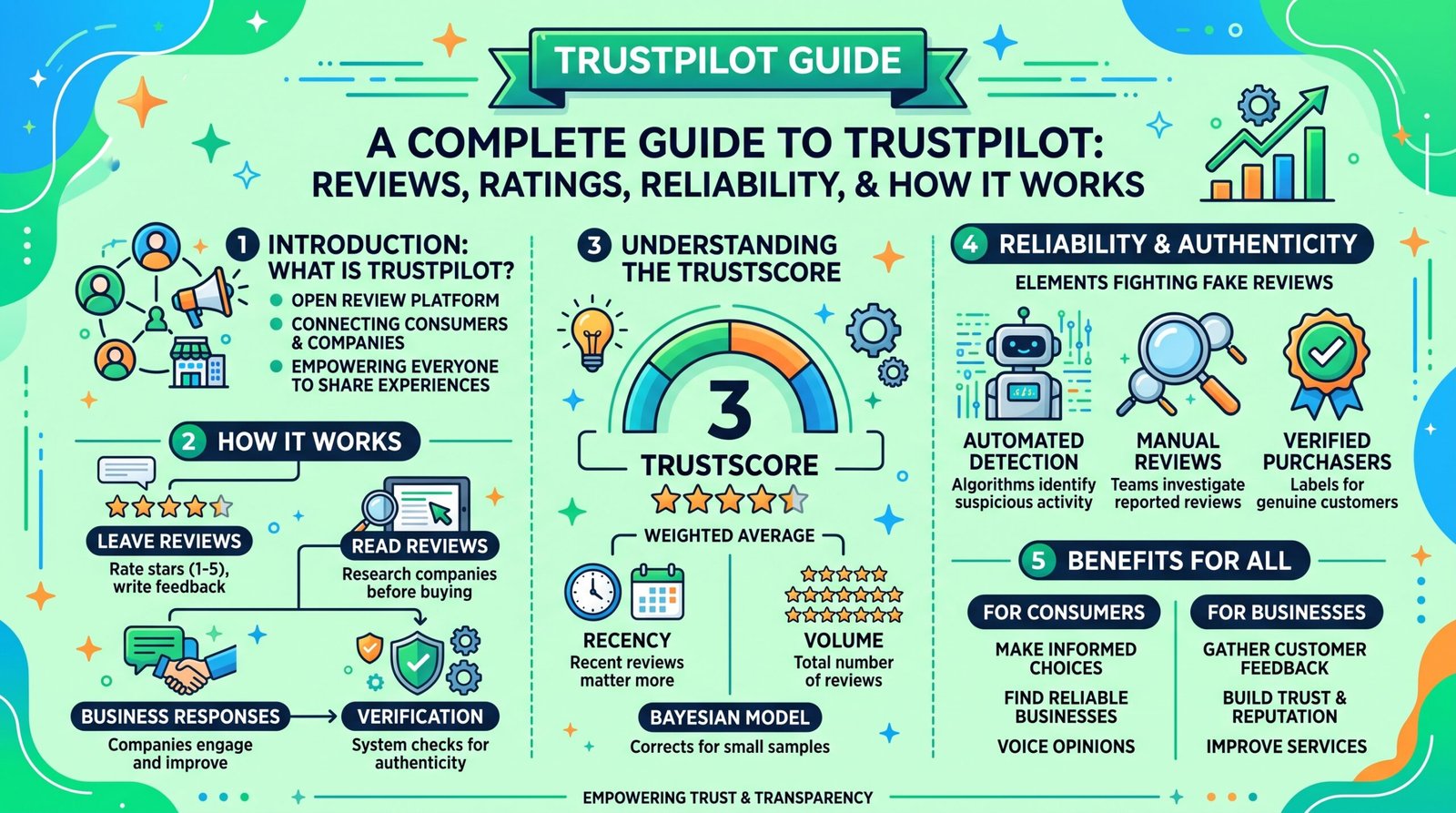
Trustpilot: A Complete Guide to Reviews, Ratings, Reliability, and How It Works
Trustpilot has become one of the most recognized online review platforms for consumers who want to learn about a business before spending their money. Whether someone is considering an online store, financial service, software provider, travel company, or subscription service, customer reviews can provide useful insight into what previous customers experienced. Trustpilot brings these experiences together by allowing users to rate businesses and share written feedback publicly.
The platform is also important for businesses because online reputation can strongly influence purchasing decisions. A company with consistent positive feedback may appear more trustworthy, while repeated complaints can alert potential customers to possible problems. However, understanding how the platform works, how ratings are calculated, and how fake reviews are handled is essential before relying entirely on any review score.
Quick Bio of Trustpilot
| Detail | Information |
|---|---|
| Name | Trustpilot |
| Type | Online Consumer Review Platform |
| Founded | 2007 |
| Founder | Peter Holten Mühlmann |
| Origin | Copenhagen, Denmark |
| Parent Company | Trustpilot Group plc |
| Main Purpose | Consumer reviews and business ratings |
| Review System | 1 to 5 stars with written feedback |
| Overall Rating | TrustScore |
| Users | Consumers and businesses |
| Business Model | Free and paid business services |
| Industry | Internet, Reviews, Reputation Management |
| Availability | International |
| Official Focus | Building trust between consumers and businesses |
What Is Trustpilot?
Trustpilot is an online platform designed to help consumers share their experiences with businesses. Customers can leave ratings and written reviews describing whether they were satisfied or dissatisfied with a company’s products, services, delivery, customer support, refund process, or overall experience.
The concept is relatively straightforward. Before purchasing from an unfamiliar company, a consumer can search for that business on Trustpilot and examine feedback left by other customers. This can provide additional information beyond what appears on the company’s own website.
Businesses also use the platform to understand customer opinions and manage their online reputations. They may respond publicly to reviews, invite customers to provide feedback, and use customer comments to identify areas where their products or services could improve.
How Does Trustpilot Work?
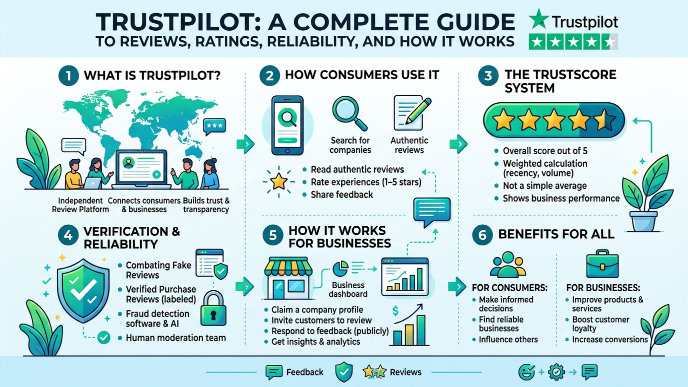
Trustpilot operates through public business profiles containing customer ratings and reviews. Consumers search for a company and can view its TrustScore, star rating, total number of reviews, recent feedback, and individual customer experiences.
Users who have interacted with a business can submit a review describing their experience. Reviews generally include a star rating ranging from one to five stars along with written comments.
The basic process usually involves finding the correct business profile, selecting a rating, writing about the experience, and submitting the review. Once published, the feedback becomes part of the company’s overall review profile, subject to the platform’s guidelines and moderation systems.
Companies can respond publicly to reviews. This feature can be particularly useful when a customer reports a problem because potential customers can see not only the complaint but also how the company handles criticism.
Understanding Trustpilot Ratings and TrustScore
One important feature of Trustpilot is its TrustScore. Although individual customers provide ratings between one and five stars, the overall score displayed for a business is intended to summarize its broader reputation on the platform.
Consumers should avoid judging a business solely from the headline number. The total volume of reviews, how recent they are, patterns in customer complaints, and the consistency of feedback can provide more useful context.
For example, a company with thousands of reviews accumulated over several years provides a different amount of information from a newly created business profile containing only a few ratings.
Recent reviews can be especially important because companies change. A business that previously struggled with customer service may improve, while another company with historically strong feedback could develop new problems.
Reading the actual reviews alongside the overall rating therefore provides a more complete picture.
Is Trustpilot Legit?
Trustpilot is a legitimate and established consumer review platform that has operated since 2007. Millions of consumers use online review platforms like it to research businesses and share customer experiences.
However, saying that the platform itself is legitimate does not mean that every individual review should automatically be accepted as completely accurate.
Online reviews are user-generated content. Different customers can have very different experiences with the same business. Some complaints may result from misunderstandings, while positive experiences may not necessarily represent every customer.
The best approach is to treat Trustpilot as one source of information rather than absolute proof that a company is safe or unsafe.
Consumers making expensive purchases should combine review research with other checks, including company information, payment protections, refund policies, contact details, independent reviews, and the overall credibility of the website.
Can Trustpilot Reviews Be Fake?
Fake reviews are one of the biggest challenges affecting the online review industry. They are not limited to one platform.
Businesses may have incentives to obtain artificial positive feedback, while competitors or individuals may attempt to post misleading negative reviews. This creates an ongoing challenge for platforms that host large volumes of user-generated content.
Trustpilot has developed automated systems and moderation processes intended to identify suspicious activity. According to the company’s transparency reporting, millions of detected fake reviews have been removed.
In 2024, Trustpilot reported removing approximately 4.5 million detected fake reviews. The company stated that most of these were identified automatically through its detection technology.
These numbers demonstrate two important points. First, fake-review activity is a genuine problem that consumers should understand. Second, major review platforms invest heavily in systems designed to identify and remove suspicious content.
No automated moderation system should be assumed to be perfect, so consumers should still evaluate reviews critically.
How to Identify Suspicious Reviews
Consumers can improve their research by looking beyond individual star ratings.
A suspicious profile may contain a sudden large number of extremely positive reviews posted within a short period. Reviews using repetitive wording, vague statements, or unusually promotional language may also deserve closer examination.
The opposite situation can occur with negative reviews. A sudden wave of one-star ratings may represent genuine widespread problems, but readers should examine whether reviewers describe specific experiences and whether similar complaints appear consistently.
Useful reviews often include practical details about ordering, delivery, product quality, customer support, billing, refunds, or problem resolution.
Patterns matter more than isolated comments.
If dozens of unrelated customers repeatedly mention delayed refunds, poor communication, unexpected charges, or delivery failures, that pattern may be more informative than one particularly emotional review.
Is Trustpilot Reliable for Consumers?
Trustpilot can be a useful research tool when used correctly.
The platform gives consumers access to a large collection of customer experiences that may reveal information unavailable in a company’s advertising. Reading both positive and negative reviews can help potential customers understand common strengths and weaknesses.
Reliability depends partly on how consumers interpret the information.
A five-star rating should not automatically convince someone to make a purchase, just as a single one-star complaint should not automatically prevent one.
Consumers should examine review volume, recent activity, recurring complaints, detailed customer experiences, company responses, and whether the overall feedback appears natural.
Using multiple independent information sources is especially important when dealing with unfamiliar businesses or expensive transactions.
Trustpilot for Businesses
Trustpilot is not only designed for consumers. Businesses can also use the platform as part of their reputation and customer-feedback strategy.
Companies can claim or manage business profiles, respond to customer feedback, invite customers to leave reviews, monitor consumer sentiment, and analyze recurring themes.
Public responses can be particularly valuable.
When a dissatisfied customer leaves a negative review, a professional response gives the business an opportunity to explain the situation, apologize where appropriate, offer assistance, or demonstrate that it takes customer complaints seriously.
Potential customers often read these responses.
A company cannot always prevent negative experiences, but the way it handles complaints can influence how future customers perceive its professionalism.
Is Trustpilot Free?
Consumers can generally use Trustpilot without paying to search for companies, read public reviews, and share eligible experiences.
For businesses, the platform operates using a freemium model. Certain basic tools may be available without payment, while additional commercial features and advanced capabilities are offered through paid plans.
Paid business tools can include expanded review-management functionality, analytics, integrations, marketing features, and tools for displaying reputation signals.
Pricing and available packages may change over time, so businesses considering premium services should evaluate whether the additional functionality provides enough value for their specific needs.
A small local company may have very different requirements from a large international e-commerce brand receiving thousands of customer interactions.
Benefits of Using Trustpilot
One of the main advantages of Trustpilot is transparency. Consumers can publicly describe their experiences, while businesses have an opportunity to respond.
For shoppers, this can reduce uncertainty when considering an unfamiliar company. Reviews may reveal important information about shipping times, customer support, product quality, refunds, subscriptions, or billing practices.
For businesses, customer feedback can reveal operational weaknesses.
If many customers repeatedly complain about slow support, confusing cancellation procedures, or delayed delivery, management can use that information to identify areas requiring improvement.
Positive reviews can also strengthen social proof. Consumers often feel more confident purchasing from a company when they can see a substantial history of detailed customer experiences.
Limitations of Trustpilot Reviews
Despite its usefulness, Trustpilot has limitations.
The biggest limitation is that online reviews are based on individual experiences. Two people using the same company may receive completely different levels of service.
Another issue is selection bias.
Customers with extremely positive or negative experiences may be more motivated to write reviews than customers whose experience was ordinary. This can sometimes make online feedback appear more polarized than the complete customer base actually is.
Fake or manipulated reviews are another concern, even though platforms use detection and moderation systems.
Consumers should therefore avoid treating any review platform as a perfect measurement of business quality.
Review sites work best as research tools rather than final authorities.
Can Businesses Remove Negative Trustpilot Reviews?
A common misconception is that businesses can simply delete any negative review they dislike.
Legitimate negative feedback is an important part of a credible review ecosystem. A negative rating generally should not disappear simply because a company disagrees with the customer’s opinion.
However, reviews may be reported when there is a concern that they violate platform guidelines. Examples might include prohibited content, fabricated experiences, inappropriate personal information, spam, or other policy violations.
The distinction is important.
Removing legitimate criticism would undermine consumer trust, while allowing clearly fraudulent or abusive content to remain would also reduce the platform’s reliability. Effective moderation therefore requires balancing open customer feedback with enforcement against manipulation and policy violations.
Why Trustpilot Matters for Online Reputation
Online reputation has become increasingly important because many purchasing decisions now begin with digital research.
Consumers frequently search for a company’s name followed by terms such as “reviews,” “legit,” “scam,” or “Trustpilot” before buying.
A strong review profile can influence trust, while repeated unresolved complaints can discourage potential customers.
This makes reputation management important for businesses.
Rather than focusing only on increasing positive ratings, companies should pay attention to the underlying customer experience. Better service, transparent policies, reliable products, responsive support, and effective complaint resolution naturally create stronger opportunities for positive feedback.
Should You Trust a Company Based Only on Trustpilot?
Trustpilot should not be the only factor used when deciding whether to trust a company.
A better approach is to combine several signals.
Check how long the company appears to have operated, whether its contact information is clear, how its refund and return policies work, what payment protections are available, and whether independent sources provide consistent information.
Then examine the Trustpilot profile carefully.
Look at recent reviews rather than only the overall score. Read both positive and negative experiences. Identify repeated complaints and observe how the company responds when something goes wrong.
For expensive purchases, financial services, subscriptions, or unfamiliar online stores, additional research can significantly reduce risk.
Frequently Asked Questions About Trustpilot
What is Trustpilot used for?
Trustpilot is primarily used for reading and publishing consumer reviews about businesses. Consumers use it to research companies, while businesses use it to collect feedback, respond to customers, and manage aspects of their online reputation.
Is Trustpilot trustworthy?
Trustpilot is an established review platform, but individual reviews should still be evaluated critically. Consumers should look at review patterns, volume, recency, detailed experiences, and other independent sources.
Are all Trustpilot reviews genuine?
No online review platform can reasonably be assumed to contain only genuine reviews at all times. Trustpilot uses automated detection and moderation systems to identify suspicious reviews and reports removing millions of detected fake reviews.
How does Trustpilot make money?
Trustpilot uses a freemium business model. Consumers can use core review functionality for free, while businesses can purchase paid plans offering additional tools and commercial features.
Can companies respond to negative reviews?
Yes. Businesses can publicly respond to customer reviews. These responses allow companies to address complaints, clarify situations, provide assistance, and demonstrate how they handle customer concerns.
What does a TrustScore mean?
TrustScore is the overall rating associated with a business’s Trustpilot profile. Consumers should consider it alongside the number, age, recency, and content of individual reviews rather than relying on the score alone.
Should I use Trustpilot before buying online?
It can be useful, particularly when researching an unfamiliar business. However, consumers should combine Trustpilot reviews with independent research, secure payment methods, refund policies, company information, and other credibility checks.
Read More: What Is Kay Burley Doing Now? Her Life and Career After Leaving Sky News
Final Thoughts
Trustpilot plays an important role in the modern online review ecosystem by giving consumers a public place to share experiences and giving businesses an opportunity to engage with customer feedback. Its large review database can help shoppers identify patterns involving customer service, delivery, refunds, product quality, and overall satisfaction. At the same time, fake reviews, individual bias, and differing customer experiences mean that no single rating should be treated as definitive proof of a company’s reliability.
The smartest way to use Trustpilot is as part of a broader research process. Consumers should read recent positive and negative reviews, examine recurring patterns, consider how businesses respond to complaints, and verify important information through additional independent sources. For readers interested in practical guides about online platforms, digital services, consumer trends, and internet topics, weeklyfanzine can continue providing informative content designed to make complex subjects easier to understand.